

A forecast in twelve versions
Group cash lives in a spreadsheet everyone updates their own way. Nobody knows which version is the right one.
Chief Financial Officer
Imported revenue, invoiced royalties, re-invoiced head-office costs, tracked loans: in GET17, every flow feeds one cash forecast. You spend less time consolidating and more time planning ahead.
What slows you down
Group cash lives in a spreadsheet everyone updates their own way. Nobody knows which version is the right one.
Management fees, fees passed between holding companies, head-office costs: every month, the same calculations and invoices all over again.
Orders on construction and CAPEX projects go out with no visibility on when the cash will actually leave.
Bank schedules in PDFs, drawdowns tracked by email: outstanding principal by bank has to be rebuilt every time.
What you gain
Projects, CAPEX, loan repayments, rents and dividends flow in automatically from the other modules. You only enter what has no dedicated module: shareholder current accounts, capital, corporate tax.
Explore the module FinanceRoyalties based on revenue, EBITDA or a flat fee, head-office costs allocated across properties, invoices generated and sent, exports to Sage and CEGID.
Explore the module CAPEXThe spending-by-category screen compares approved and ordered amounts, property by property and category by category, FF&E reserve included.
Explore the module Construction projectsAbove the configured threshold, a purchase order waits for your financial approval before it goes out. Each project's budget phasing feeds planned disbursements.
Explore the module Legal & shareholdingWhen a distribution is approved, dividends received and paid land in each company's cash forecast, with no re-keying.
Explore the module EnergyAfter the last invoice, upcoming costs are estimated from consumption and the last average unit price billed: your accruals rest on data, not guesswork.
Explore the moduleA day with GET17
Revenue, occupancy and EBITDA for every property arrive by import. One month, one record, no duplicates.
Automatic allocation computes each hotel's management fees from its revenue or EBITDA. You generate, approve and send: invoices go out by email.
The group's software licenses are split proportionally across properties. Internal invoices are generated, sent, then exported to your accounting system.
A project purchase order exceeds the financial approval threshold. With budget, quote and category in front of you, you approve it or send it back with a reason.
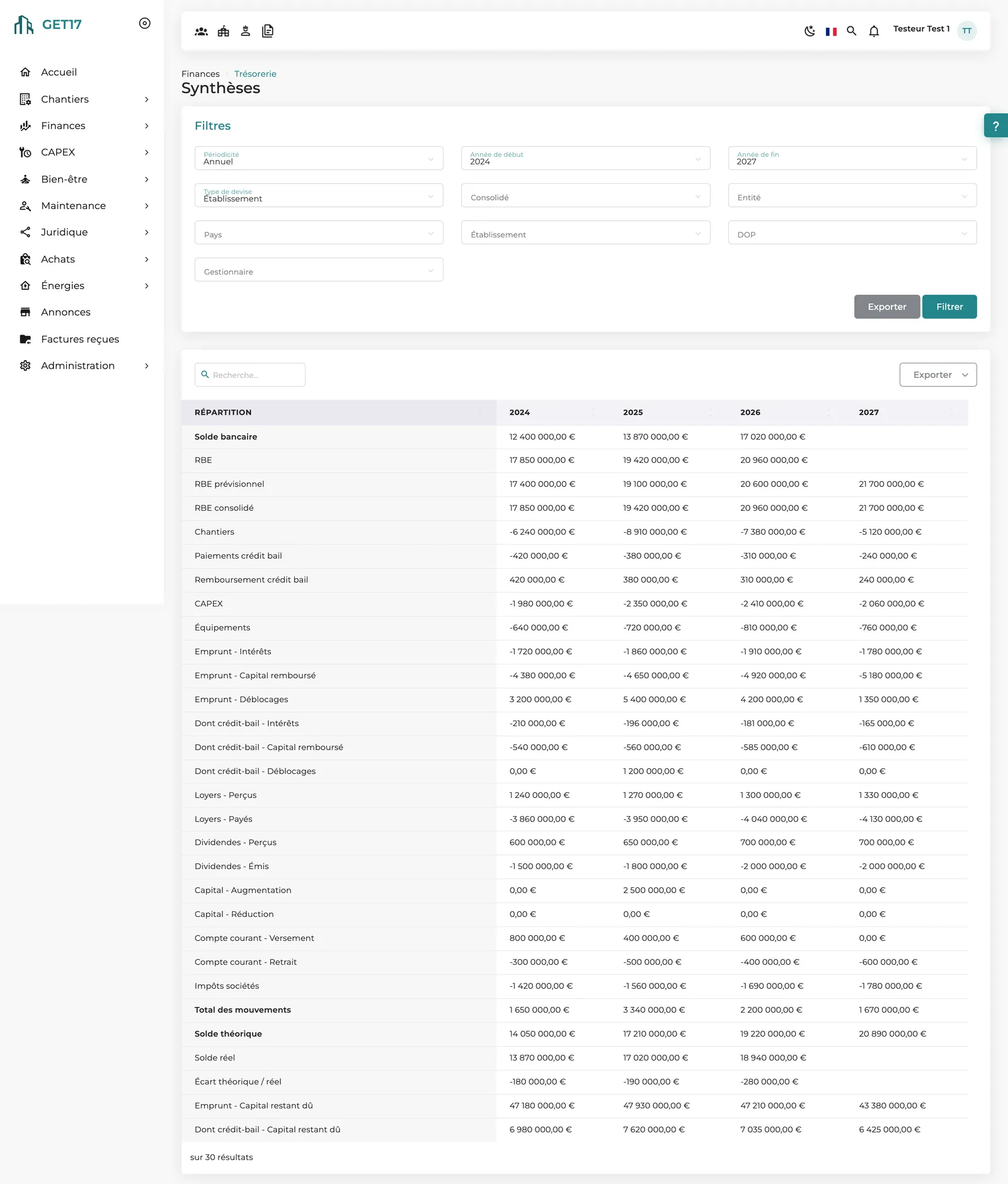
The summary sets projected balances against actual balances. You simulate financing for an upcoming project and check that EBITDA covers the repayments.
Your dashboard
Bank balance, EBITDA, projects and CAPEX, loans, rents, dividends, taxes: one row per type of flow, one column per period, down to projected balance, actual balance and the gap between them.
Frequently asked questions
No. Phasing from construction and CAPEX projects, loan repayments, rents and approved dividends come in automatically. Only shareholder current accounts, capital changes, corporate tax and dividends handled outside the platform are entered manually.
No, it complements it. Royalties and re-invoicing export to Sage or CEGID; GET17 focuses on steering the group's assets and flows.
Yes. Amounts are entered in the property's currency, and summaries display either in the group's default currency or in each property's own currency.
Only authorized finance profiles. Access rights are set by role and by property from the platform's administration.
See how GET17 brings your operating, investment and financing flows together in a single summary.